THE MANY ECONOMIC ISSUES OF THE WEIMAR REPUBLIC
The Weimar Republic had some of she most serious economic problems ever experienced by any Western democracy in history. Rampant hyperinflation, greatest rates of unemployment, and a large drop in living standards were key factors. From 1923 to 1929, there was a short time of economic recovery, but the Great Depression of the 1930s created a worldwide recession. Germany was particularly affected because it depended greatly on American loans. In 1926, about 2 million Germans were unemployed, which rose to around 6 million in 1932. Many blamed the Weimar Republic. That was made apparent when political parties on both right and left wanting to disband the Republic altogether made any democratic majority in Parliament impossible.
The Weimar Republic was severely affected by the Great Depression. The economic stagnation led to increased demands on Germany to repay the debts owed to the United States. As the Weimar Republic was very fragile in all its existence, the depression was devastating, and played a major role in the NSDAP's takeover.
Most Germans thought the TOV(Treaty of Versailles) because it forced to surrender resource-rich areas and pay massive amounts of compensation. The punitive reparations caused consternation and resentment, but the actual economic damage resulting from the Treaty of Versailles is difficult to determine. While the official reparations were considerable, Germany ended up paying only a fraction of them. However, the reparations damaged Germany's economy by discouraging market loans, which forced the Weimar government to finance its deficit by printing more currency, causing rampant hyperinflation. In addition, the rapid disintegration of Germany in 1919 by the return of a disillusioned army, the rapid change from possible victory in 1918 to defeat in 1919, and the political chaos may have caused a psychological imprint on Germans that could lead to extreme nationalism, later epitomised and exploited by Hitler.
Many historians agree many industrial leaders identified the Weimar Republic with labour unions and the Social Democrats, who had established the Versailles concessions. Although some saw Hitler as a means to abolish the latter, the Republic was already unstable before any industry leaders were starting to support Hitler. Even those who supported Hitler's appointment often did not support every bit of Nazism and considered Hitler a temporary solution in their efforts to abolish the Republic. Industry support alone cannot explain Hitler's enthusiastic support by large segments of the population, including many workers who had turned away from the left.
Princeton historian Harold James argues that there was a clear and obvious link between economic decline and people turning to extremist politics.
Here are some of the economic problems faced
1)Signing the Treaty of Versailles, 28/06/1919 - £6600 million in reparation payments
2)The Ruhr crisis of 1923 - Germany couldn't pay, and France wasn’t happy as it needed the money to pay its debts to the USA. France and Belgium occupied the Ruhr to obtain goods.
3)Hyperinflation - The government printed more money to pay the Ruhr workers.
4)The Wall Street Crash, New York, 1929 - No more help available from the USA.
Citation:http://www.bbc.co.uk/schools/gcsebitesize/history/tch_wjec/germany19291947/1riseofnazis1.shtml
Hyperinflation
Hyperinflation means to go over the limit rapidly. And that was happened to Germany"s economy.The economic disaster lasted for about 3 whole years. This happened due to considerable internal political instability in the country, the occupation of the Ruhr by foreign troops and misery for the general populace.In order to pay for the large costs of the ongoing First World War, Germany suspended gold standard
Unlike the French Third Republic, which imposed its first income tax to pay for the war, the German Emperor Wilhelm II and the German parliament (the REICHSTAG) decided without opposition to fund the war entirely by borrowing a decision criticized by financial experts such as Hjalmar Schacht as a dangerous risk for currency devaluation. The government apparently believed that it would be able to pay off the debt by annexing resource-rich industrial territory to the west and east and imposing massive reparations on the defeated Allies. The result was that the exchange rate of the mark against the United States dollar steadily devalued throughout the war from 4.2 to 7.9 marks per dollar.
The government's strategy backfired when Germany lost the war. The new Weimar Republic was now saddled with a massive war debt that it could not afford, made even worse by the fact that it was printing money without the economic resources to back it up. The Treaty of Versailles further accelerated the decline in the value of the mark, such that 48 paper marks were required to buy one US dollar by late 1919.
German currency was relatively stable at about 90 marks per US dollar during the first half of 1921.
Because the western theatre of warfare during World War I was mostly in France and Belgium, Germany came out of the war with most of its industrial infrastructure intact and in a better position to become the dominant economic force on the European continent. The London Ultimatum of May 1921, however, demanded reparations in gold or foreign currency to be paid in annual installments of 2,000,000,000 (2 billion) gold marks plus 26 percent of the value of Germany's exports.
The first payment was made when it came due in June 1921.It marked the beginning of an increasingly rapid devaluation of the mark, which fell in value to less than one third of a cent by November 1921 (approximately 330 Marks per US Dollar) The total reparations demanded were 132,000,000,000 (132 billion) gold marks, of which Germany only had to pay 50 billion marks
Because reparations were required to be repaid in hard currency and not the rapidly depreciating paper mark, one strategy Germany employed was the mass printing of bank notes to buy foreign currency, which was in turn used to pay reparations. This greatly exacerbated the inflation rates of the paper mark.
Hyperinflation[edit]

Beginning in August 1921, Germany began to buy foreign currency with marks at any price, but that only increased the speed of breakdown in the value of the mark.The lower the mark sank in international markets, the greater the amount of marks was required to buy the foreign currency demanded by the Reparations Commission.
During the first half of 1922, the mark stabilized at about 320 Marks per dollar. At this time international reparations conferences were held, including one in June 1922 that was organized by US investment banker J. P. Morgan, Jr.[ When these meetings produced no workable solution, the inflation changed to hyperinflation and the mark fell to 7,400 Marks per Dollar by December 1922.[5] The cost-of-living index was 41 in June 1922 and 685 in December, a 15-fold increase.
By the fall of 1922, Germany found itself unable to make reparations payments, since the price of gold was now well beyond what it could afford. Also by this time, the mark was practically worthless, making it impossible for Germany to buy foreign exchange or gold using paper marks. Instead, reparations were to be paid in goods such as coal. In January 1923 French and Belgian troops occupied the Ruhr, the industrial region of Germany in the Ruhr valley, to ensure this. Inflation was exacerbated when workers in the Ruhr went on a general strike and the German government printed more money in order to continue paying them for their "passive resistance." By November 1923, the American dollar was worth 4,210,500,000,000 German marks.
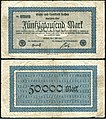 50 000 Mark, Aachen, 1923
 500 000 Mark, Leipzig, 1923
 5 000 000 Mark, Danzig, 1923
 50 000 000 Mark, Trier, 1923
 500 000 000 Mark, Dresden, 1923
 5 000 000 000 Mark, Berlin, 1923
 50 000 000 000 Mark, Plauen, 1923
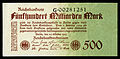 500 000 000 000 Mark, Berlin, 1923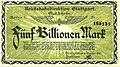
5 000 000 000 000 Mark, Stuttgart, 1923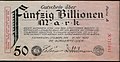
50 000 000 000 000 Eschweiler u. Stolberg 1923
CITATION for images of bank notes above:https://en.wikipedia.org/wiki/Hyperinflation_in_the_Weimar_Republic


.jpg)


.jpg)

.jpg)


Stabilization]
The hyperinflation crisis naturally led prominent economists and politicians to seek a means to stabilize German currency. In August 1923, the economist Karl Helfferich proposed a plan to issue a new currency, the "Roggenmark" ("rye mark"), which was to be backed by mortgage bonds indexed to the market price of rye grain. His plan was rejected because of the greatly fluctuating price of rye in paper marks.It was the Agriculture Minister Hans Luther who proposed a plan that substituted gold for rye and led to the issuance of the Rentenmark ("mortgage mark") backed by bonds indexed to the market price of gold. The gold bonds were defined at the rate of 2790 gold marks per kilogram of gold, which was the same definition as the pre-war gold marks. The Rentenmarks were not redeemable in gold, but were only indexed to the gold bonds. The Rentenmark plan was adopted in monetary reform decrees on October 13–15, 1923, that set up a new bank, the Rentenbank, controlled by Hans Luther, who by then had become the new German Finance Minister.

After November 12, 1923, when Hjalmar Schacht became currency commissioner, Germany's central bank (the Reichsbank) was not allowed to discount any further government Treasury bills, which meant the corresponding issue of paper marks also ceased. Discounting of commercial trade bills was allowed and the amount of Rentenmarks expanded, but the issue was strictly controlled to conform to current commercial and government transactions. The new Rentenbank refused credit to the government and to speculators who were not able to borrow Rentenmarks, because Rentenmarks were not legal tender.
On November 16, 1923, when the new Rentenmark was introduced to replace the worthless paper marks issued by the Reichsbank. Twelve zeros were cut from prices, and the prices quoted in the new currency remained stable.
When Reichsbank president Rudolf Havenstein died on November 20, 1923, Schacht was appointed president of the Reichsbank. By November 30, 1923, there were 500 million Rentenmarks in circulation, which increased to 1 billion by January 1, 1924, and again to 1.8 billion Rentenmarks by July 1924. Meanwhile, the old paper Marks continued in circulation. The total paper marks increased to 1.2 sextillion (or 1,200,000,000,000,000,000,000) in July 1924 and continued to fall in value to one third of their conversion value in Rentenmarks.
The monetary law of August 30, 1924, permitted exchange of each old paper 1 trillion mark note for one new Reichsmark, equivalent in value to one Rentenmark.
Revaluation

Eventually, some debts were reinstated to compensate creditors partially for the catastrophic reduction in value of debts originally quoted in paper marks before the hyperinflation took hold. A decree of 1925 reinstated some mortgages at 25% of face value in the new currency (effectively 25,000,000,000 times their value in the old paper marks) if they had been held 5 years or more. Similarly, some government bonds were reinstated at 2-1/2% of face value - to be paid after reparations were paid. Mortgage debt was reinstated at much higher percentages than government bonds. Reinstatement of some debts, combined with a resumption of effective taxation in a still-devastated economy, triggered a wave of corporate bankruptcies.
One of the important issues of the stabilization of a hyperinflation is the revaluation. In its customary sense, this term refers to the raising of the exchange rate of one national currency against other currencies. It also means revalorization – the restoration of the value of a currency depreciated by inflation. The German government had the choice either by means of a revaluation law to finish the hyperinflation quickly or to allow sprawling and the political and violent disturbances on the streets. The German government argued in detail that the interests of creditors and debtors had to be fair and balanced. Neither the living standard price index nor the share price index were judged as relevant. The calculation of the conversion relation was considerably judged to the dollar index as well as to the wholesale price index. In principle, the German government followed the line of market-oriented reasoning that the dollar index and the wholesale price index would roughly indicate the true price level in general over the period of high inflation and hyperinflation. In addition, the revaluation was bound on the exchange rate mark and United States dollar to obtain the value of the Goldmark.
The Law on the Revaluation of Mortgages and other Claims of 16 July 1925 (Gesetz über die Aufwertung von Hypotheken und anderen Ansprüchen or Aufwertungsgesetze, a.k.a. the Revaluation Act 1925) finally included only the relation of paper mark to gold mark for the period from January 1, 1918, to November 30, 1923, and the following days.[This led to the abandonment of the principle A mark is worth a mark recognized until then (the nominal value principle), because of the galloping inflation.[This law was challenged in the Supreme Court of the German Reich (Reichsgericht). The 5th Senate of the German Supreme Court (Reichsgericht) ruled on November 4, 1925, that the Revaluation Act 1925 was constitutional, even when weighed against the "Bill of Rights and Duties of Germans" (articles 109, 134, 152, and 153 of the Constitution). This case was precedent-setting for the issue of judicial review in German jurisprudence.
Identifying hyperinflation
The hyperinflation episode in the Weimar Republic in the early 1920s, although not the first or most severe instance of inflation in history (the Hungarian pengő and Zimbabwean dollar, for example, have been even more inflated), has been the subject of the most scholarly economic analysis and debate. The Weimar hyperinflation drew significant interest, as many of the dramatic and unusual economic behaviors now associated with hyperinflation were first documented systematically: order-of-magnitude increases in prices and interest rates, redenomination of the currency, consumer flight from cash to hard assets, and the rapid expansion of industries that produced those assets. German monetary economics was at that time heavily influenced by Chartalism and the German Historical School, and this conditioned the way the hyperinflation was analyzed.John Maynard Keynes described the situation in The Economic Consequences of the Peace: "The inflationism of the currency systems of Europe has proceeded to extraordinary lengths. The various belligerent Governments, unable, or too timid or too short-sighted to secure from loans or taxes the resources they required, have printed notes for the balance."
It was during this period of hyperinflation that French and British economic experts began to claim that Germany destroyed its economy with the purpose of avoiding reparations, but both governments had conflicting views on how to handle the situation. The French declared that Germany should keep paying reparations, while Britain sought to grant a moratorium that would allow for its financial reconstruction.
Reparations accounted for about one third of the German deficit from 1920 to 1923,] and were therefore cited by the German government as one of the main causes of hyperinflation. Other causes cited included bankers and speculators (particularly foreign). The inflation reached its peak by November 1923, but ended when a new currency (the Rentenmark) was introduced. In order to make way for the new currency, banks "turned the marks over to junk dealers by the ton"to be recycled as paper.
Results

Banknotes in Germany had lost its value so much that it was being used as wallpaper! Citation: Wikipedia
The hyperinflated, worthless marks became widely collected abroad. The Los Angeles Times estimated in 1924 that more of the decommissioned notes were spread about the United States than existed in Germany.[
 |
| A 5 billion mark postage |
Here are documentary videos regarding the hyperinflation:
1)https://youtu.be/ARk5XVmojgY
2)https://www.youtube.com/watch?v=l9wESPmZrrw

No comments:
Post a Comment